

Overview
The purpose of this study is to identify targeted improvements to enhance traffic flow on Interstate 84. The study will evaluate potential lane additions and the use of ramp metering to determine their effects on traffic operations throughout the corridor. It will also develop phasing recommendations for potential future projects.
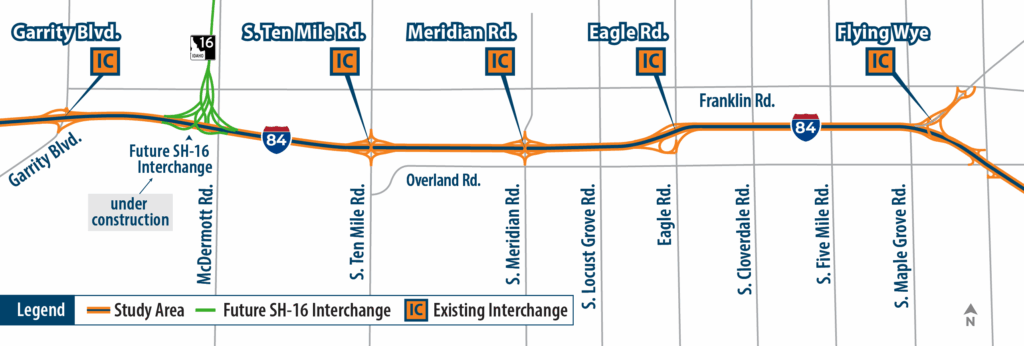
Why We Need this Study
Continued development, traffic, and growth have strained I-84 during the morning and evening commutes.
- Traffic volumes on I-84 have increased over the last five years by an average of almost 10%, with larger increases in the western segments.
- The on-ramps from the interchanges to I-84 experience significant congestion during commute times and highway users often back up onto cross streets.
- The off-ramps have similar congestion issues during commute times, backing traffic up onto I-84.

Study Alternatives
This study will evaluate a range of alternatives designed to improve traffic flow and reduce congestion along the I-84 corridor. The analysis will consider both physical improvements and operational strategies to determine what combination of tools would be most effective.
These strategies include alternatives that would widen I-84 to five lanes in each direction or add an auxiliary lane between interchanges in each direction and evaluating intelligent transportation system (ITS) strategies and ramp metering to determine how they could work with the alternatives above to reduce congestion.
ITS strategies identify real time information on the freeway and share it with travelers and ITD, allowing ITD to adjust signals to better serve traffic. These could include:
- Travel time displays on overhead signs to let travelers know how long it will take to reach their destination.
- Automatic incident detection to let ITD and travelers know of crashes and incidents on the freeway.
- Stopped vehicle detection system to let ITD and travelers know of vehicles stopped on the freeway.
- Traffic signal control systems to better coordinate signals to keep traffic moving.
Ramp meters are traffic signals on freeway on-ramps that regulate how vehicles enter the freeway. When the signal is red, vehicles stop at the ramp; when it turns green, they proceed and merge into traffic. Ramp metering has been shown to increase freeway speeds, reduce congestion and delay, and improve safety by smoothing merges and reducing collisions. However, it can result in additional queuing on ramps and nearby local roads.
ITD will not be investigating high-occupancy vehicle (HOV) lanes as that feature does not comply with state law.

Next Steps
ITD will develop a phasing plan showing recommended improvement projects and what order they should occur in. There is currently no funding for construction at this time.
The study started January 2025 and will be complete by summer of 2026. Then, ITD will host an online public information meeting presenting results of the study.

Eric Grossarth
Project Inquiries