

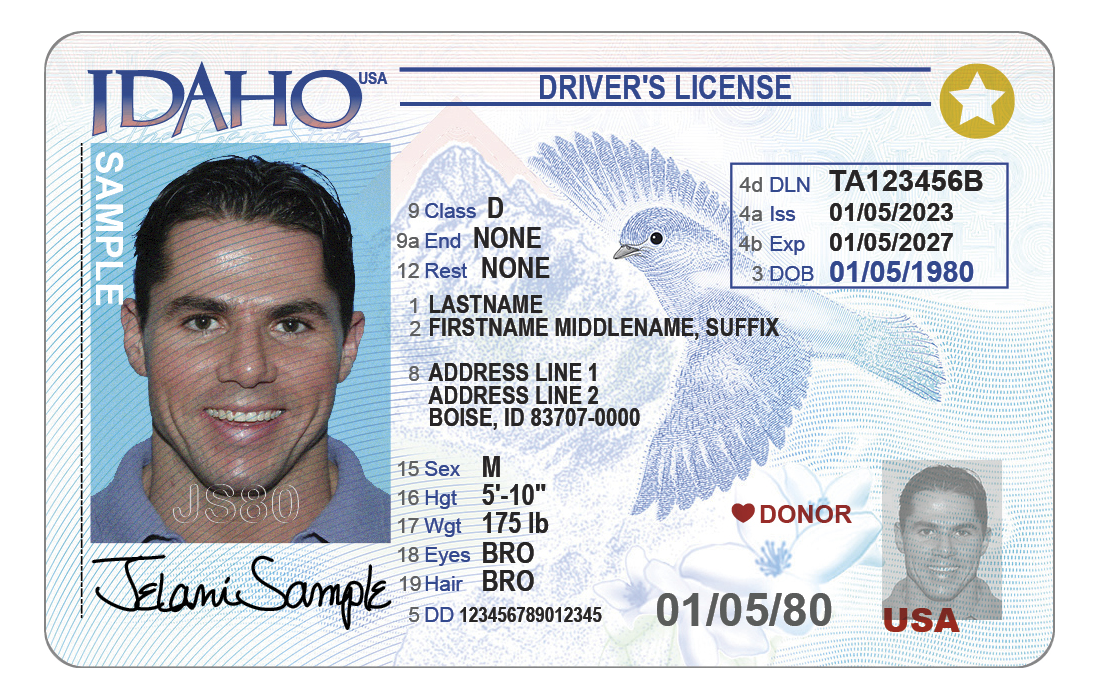
Step 1: Driver's License or ID Card
You must get an Idaho driver’s license or ID card within 30 days of moving to Idaho, whether your out-of-state ID has expired or not. Students attending an Idaho college or university and members of the military on active duty and dependents do not need to apply for an Idaho driver’s license if they have a valid out-of-state license.
In order to get an Idaho license or ID card, the DMV needs to see proof of U.S. Citizenship or Lawful Presence, identity, Idaho residency, and name.
While you’re already gathering your documents, provide a second, different proof of Idaho residency and get your Star card, Idaho’s Real ID. Visit the Star Card webpage for more information.
Driver’s License and ID Required Documents
Knowledge Test
If you are a new driver, or never had an Idaho license before you will need be tested on Idaho traffic laws, highway signs by shape and symbol, traffic signals, pavement marking, and equipment required on motor vehicles. For more information and practice tests, visit the Taking the Driver’s Test page.
Driving Skills Test
You may have to take a skills test if you:
- Have never had a driver’s license before,
- Have completed driver’s training and the supervised instruction period,
- Your license has been expired for 25 months or more,
- If your driver’s license is from a foreign country (except Germany, Korea, or Taiwan), or
- If your vision does not meet minimum standards.
- If you have any mental or physical impairment that might affect the safe operation of a motor vehicle, or
- When an examiner has concerns about the applicant’s ability to safely operate a motor vehicle, regardless of prior license, experience, or age.
Vision Screening
Your vision will be screened, and you must meet a minimum standard of 20/40 vision in at least one eye, with or without corrective lenses. If you wear glasses or contacts during the screening, a lens restriction will be placed on your driver’s license. If the lens restriction is placed on your driver’s license, you must always wear your glasses or contacts when operating a vehicle or you could be cited and lose your driving privileges for a period of time.
Idaho driving handbooks
If you are 18 years of age or older, you may request to have the “DONOR” designation appear on your license or ID card. If you are 16 or 17 years old, you may be a donor but must have parental permission to be on the donor registry. The designation identifies your wish to donate your organs and/or tissues upon your death to those waiting for transplants. If you want to make limitations, change, or update your donor status, visit the Yes Idaho website or call 1-866-YES-IDAHO.
Federal law requires all males who are 18 to 25 years of age to register with the Selective Services System (aka the Draft). The Selective Service System receives notification of any eligible individual not currently registered at the time of application.
Veterans Designation Guide

Step 2: Vehicle title, registration, and plates
Whether your out of-state vehicle registration has expired or not, you must title and register your vehicle within 30 days of moving to Idaho.
- Bring the vehicle you want to title and register with you to the DMV. A DMV employee will inspect the vehicle’s identification number (VIN) at that time.
- Bring your vehicle’s current title and registration. If the vehicle has not been titled in your name, be sure the title has been signed and the price entered in the designated area of the title. You will also need the bill of sale from the seller if the price is not provided on the title.
- If the title is being held by a lienholder, bring the lienholder’s name and address.
- If your title has been lost, you will need to apply for a duplicate title from the state of issuance.
- Bring your personal identification.
- You must change your vehicle registration to Idaho.
- Make sure your liability insurance is with an admitted carrier in Idaho by letting your insurance company know that you’ve moved to Idaho. Idaho verifies insurance coverage electronically. Failure to maintain insurance can result in suspension of registration fees.
- You must have the following minimum coverage:
- $25,000 for injury or death of one person in any one accident
- $50,000 for injury or death of two or more persons in any one accident
- $15,000 for damage or destruction of property of others in any one accident
When you visit the DMV to title and register your vehicle, you will also need to order license plates. License plates are unique identifiers for your vehicle and come in a variety of designs. License plates are made to order and are shipped by the US Postal Service. Please allow 6 weeks for new plates to arrive. You can track your plate order in the DMV Online Portal.
Step 3: Find a local office
Check out the DMV locations page to find a local office near you. DMV offices are operated by the Sheriff’s Office and/or Assessor’s Office of your county. Please note that some offices only provide driver’s license or motor vehicle services, while some provide both. Some offices take appointments, and some do not.
Bring Cash, check, or credit card to pay the fees and taxes. Fees and taxes for registering a vehicle in Idaho vary depending on what type of vehicle you have, its age, purchase price, and the county in which you live.
Step 4: Set up your DMV Online account

Now that you have been to the DMV for the first time, you can manage your account online! The DMV Online Portal allows you to renew, your license or ID card, your registration, order new plates, change your address and more.
Your first time logging on to the DMV Portal you will need to provide your social security number (SSN). This information is already on file with the DMV. We ask for your SSN to verify that you are who you say you are and so that another person can’t fraudulently set up a DMV online account in your name.