
Outdoor Advertising
As part of the Highway Beautification Act, also known as the Lady Bird Johnson Act, federal law requires all states to provide continuing, effective control of outdoor advertising (Title 23, U.S. Code, Section 131). Failure to comply may result in a 10 percent reduction in Idaho’s Federal Highway funds.
Before you install a sign next to a controlled highway, you need a permit from ITD. First mark the proposed location of your sign with stakes so the site can be inspected by ITD, then file a permit with the ITD Right of Way Section.
Outdoor Advertising Documents
With your application you must include:
- A $10 non-refundable application fee
- Proof of local approval (if applicable), such as an approved building permit for the sign
- Zoning type and signature of local zoning authority
- The property owner´s signature and contact information. If you don’t have the property owner’s signature, you may provide a copy of a lease for the sign site. NOTE: Licensed sign companies are required to provide a copy of a lease from the property owner that includes signatures and a termination date.
- A site plan, which is a sketch of the proposed sign on the subject parcel showing the sign’s proximity to structures, property lines (applicants are responsible for establishing property lines), highways, overpasses, interchanges, driveways, power lines, waterways, sidewalks, etc.
- A plan-view showing the sign configuration from all angles, including from above. Make sure to include any illumination and cat walks.
- A copy of the last deed of record to confirm ownership of the property where the proposed sign will be located.
ITD may ask you to provide additional information needed to process your application. Processing time is approximately 14 days. The annual renewal fee for sign permits is $3.
You will have 180 days from the permit issuance date to complete the installation of your sign structure and sign face. ITD will inspect the sign 180 days from the permit issuance date to make sure the sign complies with the information provided in your application.
If your property borders a controlled highway, you will need to contact an ITD Office because there are some state restrictions, however, an ITD permit is not required. Your sign must also comply with city or county sign ordinances. If your local government approves your sign, the state of Idaho allows:
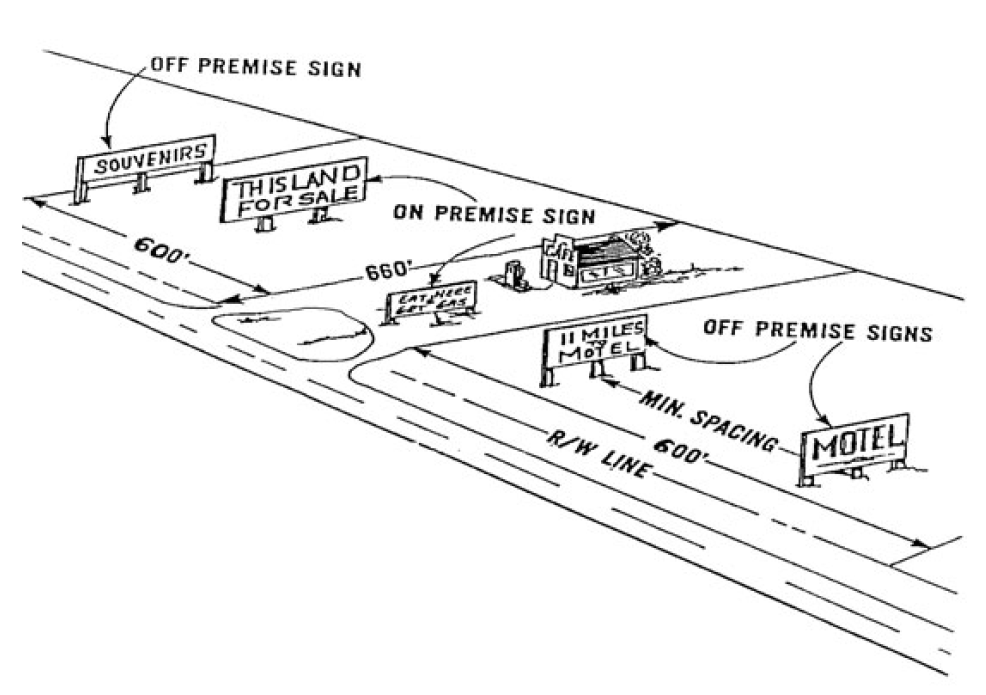
- On-premise signs advertising activities conducted on the property where the sign is located (including subdivision signs and real-estate signs). There can only be one sign visible to traffic proceeding in any one direction (see diagram above).
- “For Sale” signs on the property advertised for sale.
Please check with the Right-of-Way Section at ITD to make sure your sign fits in one of the above categories.
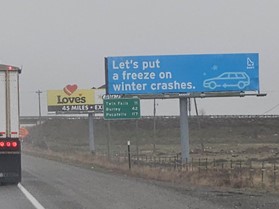
You can put a sign for your business on someone else’s property along a state highway. This is called outdoor advertising.
- The sign must have an ITD Permit.
- The sign must follow local ordinances and, if required, you must have a local permit.
- The sign site must be on commercial or industrial-zoned property.
- You must have the property owner´s permission.
- There must be a visible, licensed business or industry that has been in operation for at least six months on the property.
If you are a realtor or the owner of property along a state highway you can put one sign visible to each direction of travel on the property. A permit is not required.
Placing a property-for-sale sign on someone else’s property along a state highway is considered outdoor advertising and is subject to the following:
- You must get a permit prior to placing the sign on the property.
- Access to the sign cannot be solely from the state highway right-of-way.
- Property-for-sale signs are not allowed in the state highway right-of-way.
Subdivision entryway signs along state highways are considered outdoor advertising and must be located within the subdivision boundaries and cannot be placed within the highway right-of-way.
If you want to place a sign along a state highway to advertise or inform the traveling public that your subdivision is located nearby, you must obtain an ITD Permit prior to placing the sign along the highway.
There are certain areas where signs are prohibited by law. The following is a partial listing of some of the areas signs are not allowed, such as:
- Along scenic byways, which are specially designated highways protected for their scenic or historic value. Existing signs are allowed to remain along scenic byways, but new signs may not be erected.
- In the right-of-way of any highway.
- Within a stream or drainage canal.
- In any location that hinders the clear, unobstructed view of approaching or merging traffic, or obscures from view any traffic sign or other official sign.
- In any location that obscures the view of any connecting highway or intersection.
Signs may also be prohibited if they are visible from interstate or primary highways and are:
- Not maintained in safe condition.
- Not clear or in good repair.
- Painted, affixed, or attached to any natural feature (rock, tree, etc.)
- Simulating or imitating any directional, warning, danger, or information sign.
- Intended or likely to be construed as giving traffic warnings.
- Illuminated or positioned in a way that interferes or obscures an official traffic sign, signal, or device.
- Displaying any red, blue, or blinking light likely to be mistaken for a warning or danger signal, or any light that may blind or distract drivers.
Outdoor advertising signs placed along state highways:
- Can be no larger than 1,000 square feet. (A 48-foot by 14-foot sign is 672 square feet.)
- Can have a sign face no more than 30-feet high and no wider than 50 feet. This includes the border, trim, cutouts, and extensions, but does not include supports and decorative bases.
- Must be at least 500 feet from other signs along interstate highways.
- Must be at least 250 feet from other signs along primary highways outside of urban areas. Additional restrictions may apply.
- Must be at least 100 feet from other signs along primary highways within urban areas.
- May not be located adjacent to a highway and within 500 feet of the following:
- public parks, public forests, and public playgrounds
- scenic areas designated as such by ITD or other state agency
- railroad overpasses
- the point of pavement widening at the entrance or exit to a port-of-entry weight-checking station, or port of entry or other state-operated facility for motorists
- highway grade separations structures, where the highway passes beneath a railroad or highway and there is no traffic connection between the highways
- May not be located within the actual interchange area, defined as commencing or ending at the beginning of pavement widening at the exit or entrance to the main traveled way of the freeway. Note: existing permitted signs are allowed but are classified as non-conforming signs.
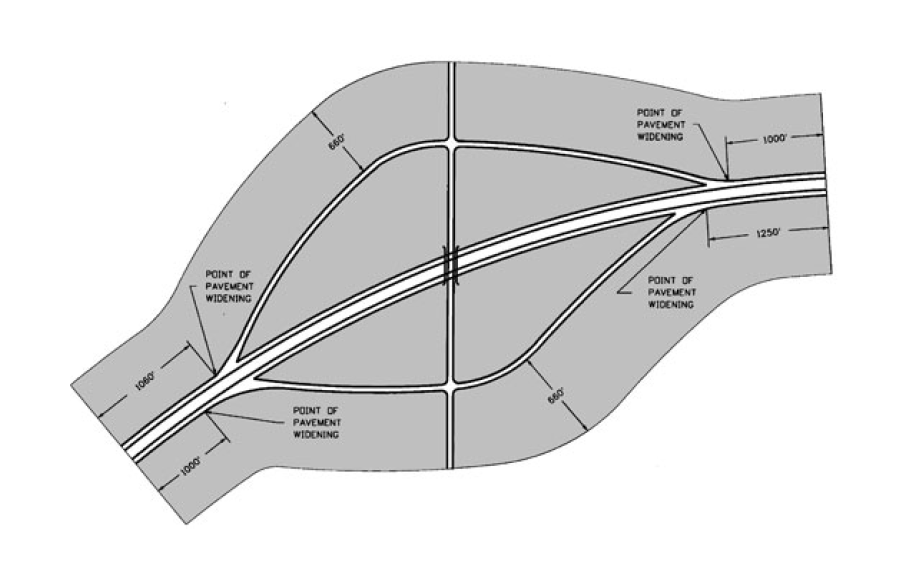
- May not be located within 100 feet of the right-of-way line of the intersecting road where intersections are more than 500 feet apart, unless buildings or structures control cross vision. In such cases, advertising signs may be allowed up to and on top of the intervening structures.
- May not be located within 50 feet of the right-of-way line of an intersecting road where intersections are 500 feet or less apart. However, to assure visibility under the signs, the bottom edge of all signs (excluding posts) that are between 50 and 100 feet from an intersecting road´s right-of-way line must be at least 14 feet above the travel surface of the road.
- If electronic, must display a static image for a minimum of eight seconds, and have a dwell time of two seconds or less. Electronic sign faces must be at least 5,000 feet apart on interstates, at least 1,000 feet apart on primary highways in urban areas, and at least 5,000 feet apart on primary highways outside of urban areas.
Distances between and from signs are measured horizontally along the pavement edge nearest the signs. Distances are measured from the point of the sign nearest to the highway.
Alleys, undeveloped rights-of-way, private roads, and private driveways do not qualify as intersecting streets, roads, or highways.
There are several options available to public agencies and non-profit organizations:
- Directional signs pertaining to public places owned or operated by federal, state, or local governments, or their agents; publicly and privately owned natural phenomena, historical, cultural, scientific, educational, or religious sites; and areas of natural scenic beauty or areas naturally suited for outdoor recreation deemed to be in the interest of the traveling public. Directional signs must have a maximum area of 150 square feet, a maximum height of 20 feet, and a maximum length of 20 feet.
- Non-commercial signs such as “Welcome to . . .” community signs. Welcome signs cannot exceed 300 square feet. Only one welcome sign will be allowed for each route entering a community.
- The following signs cannot be larger than eight square feet, but still require a permit from the Idaho Transportation Department:
- service club signs
- church or other religious signs
- charitable association signs
- Directional signs relating to communities that have been bypassed by a highway. These signs must be located within five miles of the bypassed community.
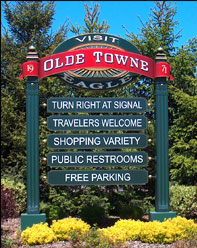
Public agencies are required to obtain an ITD Permit. Contact your local ITD Office for specific information regarding the location, size, spacing, and message content.
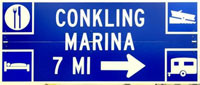
Tourist Oriented Directional Signs (TODS)
Tourist Oriented Directional Signs are available along the state highway system to provide directional information to tourist-oriented businesses, seasonal agricultural products, services, and attractions that cannot be seen from the highway. Tourist Oriented Directional Signs are not allowed along interstate highways.
Please contact your local ITD District Office for more information.
Motorist Service Information Signs
The intent of the logo sign program is to provide the availability of specific service signage to a business or activity that offers specific motorist services that are of interest to the traveling public. It is the sole intent of this program to provide motorist information to the traveling public and not to promote outdoor advertising of a business or activity.
Please contact your local ITD District Office for more information.