
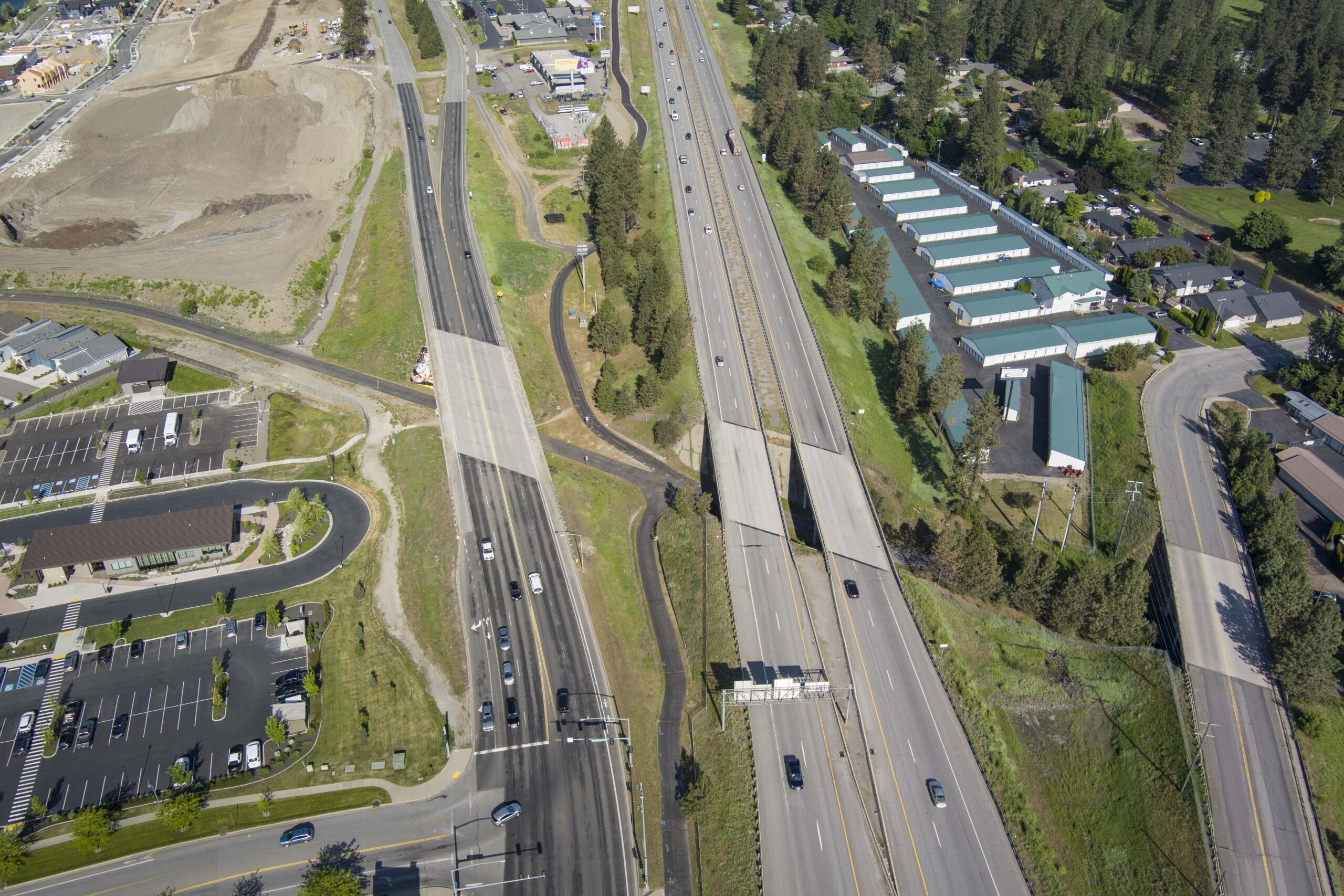
Construction is Underway!
OVERNIGHT RAMP CLOSURES
Drivers will experience short-term, overnight ramp closures on I-90 near the SH-41 interchange now that the traffic crossover is in place:
- Traveling from Coeur d’Alene toward Post Falls: Drivers will not be able to exit westbound I-90 at State Highway 41 (Exit 7) from 8 p.m. to 5 a.m. nightly from Wednesday, Oct. 21, through Friday, Oct. 23. The off-ramp will reopen each morning, with the final closure ending Saturday morning. I-90 traffic will be detoured to the exit at Seltice Way.
- Entering I-90 in Post Falls toward Spokane: The westbound on-ramp at SH-41 will close from 8 p.m. Wednesday, Oct. 21, to 5 a.m. Thursday, Oct. 22. Drivers should use Spokane Street to enter westbound I-90 during this one-night closure.
I-90 PAVING
- Recent I-90 paving work is complete. Eastbound lanes are fully open, and westbound lane restrictions will likely stay in place through early November along with the closure of the I-90 westbound off-ramp to Northwest Boulevard.
- The I-90 westbound on-ramp from Northwest Boulevard is open.
ADDITIONAL IMPACTS
- I-90 traffic shift: I-90 westbound traffic has shifted to the south side of the freeway and is expected to remain that way for a full year.
- Huetter Road closure: Anticipated to start the morning of Oct. 26, Huetter Road beneath the interstate will close for up to one weeks to demolish the I-90 bridge over Huetter. Drivers should use Atlas Road as an alternate route.
- Atlas Road closure: Once Huetter re-opens, Atlas Road will close for up to two weeks while similar bridge demolition takes place. During this closure, drivers will use Huetter Road as an alternate route.
TRAIL IMPACTS
With heavy equipment and crews active throughout the project corridor, the adjacent trails will continue to experience ongoing and intermittent impacts. ITD reminds all trail users to slow down, stay alert, and follow signage near the work zones.
- Prairie Trail is closed
- Prairie Trail under I-90 is closed under I-90 as crews complete the next phase of demolition. The trail is anticipated to re-open by Oct. 24.
- Centennial Trail closure
- The Centennial Trail remains closed between Northwest Boulevard and Atlas Road to accommodate I-90 widening construction and city waterline improvements. Pedestrian and bicycle traffic is being detoured via Riverstone Drive and the south side of Seltice Way. (See complete map detour in the Resources).
Throughout the project duration, drivers can expect:
- Work will typically occur Monday through Friday with both daytime and nighttime activity, though some weekend work may occur as well.
- Variable speed limits, with digital signs adjusting speeds based on nearby work activity. Drivers should pay extra close attention to the posted speed limits and drive accordingly.
- Trail users should expect intermittent impacts throughout the I-90 corridor as construction progresses. ITD reminds all pedestrians and bicyclists to slow down, stay alert, and follow posted signage near work zones.
Please note, construction schedules and impacts are subject to change.
Overview
The five miles of Interstate 90 from State Highway 41 to U.S. Highway 95 are the most heavily traveled and congested in the corridor. This is the first construction project to advance from the I-90 Corridor Study from SH-41 to 15th Street to enhance safety and add lanes to support future traffic volumes. Construction started in August 2025 and is scheduled to take four years to build, ending in 2029.
Reminder for I-90 Drivers
With ongoing traffic shifts, heavy equipment, and crews working throughout the corridor, ITD reminds all drivers to slow down, stay alert, and follow posted speed limits in the work zone.
Through traffic on I-90 should keep left to allow space for vehicles to safely merge. These measures are critical for the safety of both the traveling public and construction crews.
Under Construction
Improvements on I-90 from the SH-41 Interchange to the US-95 Interchange include:
- Add two lanes in both eastbound and westbound directions of I-90 for a total of four lanes in each direction
- Replace and widen bridges over Huetter Road, Atlas Road, and Prairie Trail
- Realign and improve adjacent sections of Prairie Trail and Centennial Trail
- Lengthen existing on- and off-ramps to allow for a safer merging with I-90 mainline traffic.
- All ramps at the Northwest Blvd. Interchange
- Eastbound off-ramp at US-95
- Westbound off-ramp at US-95
Traffic Impacts During Construction
During construction, travelers can expect a variety of impacts throughout the project area aimed at maintaining traffic flow and ensuring safety. It’s important to understand that schedules and construction impacts may change.
Key changes will include:
- Two-lane traffic maintained in each direction during daytime hours.
- Reduced speed limits and increased fines in work zones for safety.
- Short-term detours on Huetter Road and Atlas Road during bridge construction.
- Ramp closures for up to one week for widening and reconstruction, as needed.
- Reduced shoulder widths throughout the project area.
- Intermittent impacts to the trails including detours and gravel surfaces.
Trail Impacts During Construction
Construction along the I-90 corridor will cause intermittent impacts to the Centennial Trail and nearby bicycle and pedestrian routes throughout the project. Impacts may include detours, gravel surfaces, reduced speed zones, lane closures, and full trail closures.
Check the yellow alerts box at the top of this page for the latest information. ITD updates this section as soon as new impacts are confirmed, so it’s your best source for current conditions.
With heavy equipment and crews active throughout the corridor, the adjacent trails will continue to experience impacts. ITD reminds all trail users to slow down, stay alert, and follow signage near work zones.
Safety Benefits
Widening the interstate will allow for better flow of traffic, eliminating stop-and-go conditions that could result in rear-end crashes. With more lanes, drivers have room to maneuver through traffic, reducing the need for sudden lane changes.
Ramps will be lengthened and brought up to standard, allowing more time to merge safely. Drivers will also be able to address emergency issues with wider shoulders that put more space between them and high-speed traffic, as well as allow for better response time for emergency services during crashes.
Community Involvement
Since 2021, several open houses, surveys, meetings with interested parties, and other public involvement opportunities took place as part of the I-90 Corridor Study. The feedback gathered during those efforts helped shape the final design for this project.
Funding
The I-90 widening between SH-41 and US-95 is funded by Governor Little’s Leading Idaho initiative. The program allows ITD to accelerate project timelines to address rapid growth and build critical infrastructure that would otherwise take many years to fund and build.
The widening improvements from SH-41 to US-95 are estimated at approximately $200 million to $210 million*, which includes design, right of way, and construction costs.
Future design and construction phases of this corridor will be determined based on statewide needs and funding availability.
View TECM Funding
*Costs are estimated in 2025 dollars.

Frequently Asked Questions
There are two main reasons for the removal. First, there is a need to create the space necessary to add capacity to the interstate. As the project is being built almost entirely within ITD’s existing right of way (largely inward, within the wide existing median area), the highway can be expanded with minimal impact to adjacent property owners. Unfortunately, the tradeoff is the removal of trees that people have grown attached to over the years. Second, safety is a factor. Trees of this size and proximity to the highway can pose risks to drivers, especially in severe weather if they fall into the roadway. They can also block sunlight from reaching the pavement, creating shady spots where patchy black ice is more likely to form in winter. Finally, any fixed object (tree, sign, light pole, etc.) on the roadside is a potential hazard for vehicles who lose control and leave the roadway. Eliminating these “strike hazards• where possible can helps reduce those risks for drivers while also saving on the costs of repairing damaged infrastructure. ITD recognizes the value of preserving a sense of place and this is a factor in decisions made throughout project life cycles. It’s understandable that some may feel strongly about the tree removal, as ITD also appreciates the natural ambiance of the region. Change is difficult, but these steps are necessary to expand the interstate safely and efficiently while limiting impacts to private property.
Noise walls will not be constructed as part of this project.
As required by federal regulations, ITD completed a traffic noise analysis to evaluate potential noise impacts from the project and to determine whether noise abatement measures, such as noise walls, were both feasible and reasonable under the ITD Noise Abatement Policy.
The analysis identified some areas where traffic noise levels are expected to increase and meet the initial criteria for consideration. However, under federal and state policy, a noise wall must also meet a reasonableness standard, which includes factors such as cost effectiveness, overall benefit, and whether the wall can be justified compared to available funding. For this project, the analysis determined that while some locations meet impact thresholds, noise walls do not meet the reasonableness criteria due to cost, and therefore were not recommended.
This distinction is important: only noise walls that are recommended through the formal noise study are eligible for project funding. If a wall is not recommended, it cannot be funded or constructed as part of the project.
ITD follows this standardized, federally-directed process to ensure that limited transportation funds are distributed consistently, equitably, and fairly across communities statewide. Applying the same analysis and decision-making criteria to every project helps ensure that noise abatement decisions are based on data, policy, and funding eligibility.
The noise analysis full report is available for review.
Contact the Project Team
For questions or comments about this project, please contact the project team at info@i90corridor.com or (208) 738-4190.
Sign up for email notifications
Stay up to date with important information and news about the I-90 expansion project between Post Falls and Coeur d'Alene!
Sign up for text notifications
Stay up to date with important information and news about the I-90 expansion project between Post Falls and Coeur d'Alene!