
Overview
Work Completed So Far
To date, the study team has completed the following activities:
- Developed and evaluated potential crossing alternatives
- Goal setting for potential improvements
- Collected and analyzed current and future transportation data
- Analyzed traffic patterns, including where people are traveling to and from
- Conducted stakeholder outreach through interviews and working groups
- Hosted two public open houses in summer 2025 to share study findings and gather initial feedback
Next Steps: Funded Initiatives
As a result of the study findings, the Idaho Transportation Board has approved funding to advance three initiatives:
- US-93/Blue Lakes Blvd./Pole Line Rd. Intersection Improvements including analysis, a value engineering study, and preliminary planning
- SH-50/SH-30 Corridor Planning (Red Cap Corner to I-84) including widening or replacement of the Hansen Bridge
- Snake River Crossing study will advance into the environmental review (NEPA) phase with an emphasis on securing federal funding for potential new crossing
Each initiative will proceed independently starting in 2025. The Snake River Crossing Study will continue with an emphasis on building regional consensus for a potential third river crossing.
Community Involvement
Early in the study, ITD worked with local jurisdictions and stakeholders across the Magic Valley to better understand transportation needs and identify potential improvements.
Public engagement has remained a key part of the process. Public meetings were held in June and August 2025 to share findings, present initial concepts, and gather feedback on project goals for a potential new crossing. These meetings had a combined 481 in-person participants, 4,596 online participants, and 344 comments received.
Public involvement will continue as the project moves into the environmental review phase. ITD will host additional public meetings and hearings at key milestones throughout the NEPA process.
The June and August 2025 public meeting summary is now available.
Responses to frequently asked questions are included in the summary document and the Frequently Asked Questions section of this site.
Timeline
-
2022
ITD begins US-93 Snake River Bridge Feasibility Study.
-
2024
Idaho Transportation Board approves funding to advance three separate initiatives resulting from the feasibility study.
-
Summer 2025
ITD hosts public meetings to share study findings, present initial concepts, and gather feedback.
-
Early 2026
ITD begins meeting with resource agencies and prepares the project to advance to environmental review.
-
May 2026
ITD Board approves spending authority to advance the project into environmental phase.
-
Mid 2026
ITD plans to work with the Federal Highway Administration (FHWA) to issue the Notice of Intent, formally initiating the NEPA process, anticipated to begin by mid-2026.
-
Future Phases
Design and construction phases have not been established and are not currently funded.
Frequently Asked Questions
ITD will gather resource agency feedback in early 2026, finalize materials with FHWA, and is anticipated to begin the NEPA environmental review by mid-2026, which is expected to take approximately two years to identify a preferred alternative. While the NEPA phase is state-funded, future design and construction are not yet funded and will require a mix of state and federal funding, along with long-term regional collaboration.
The project is evaluating a potential new Snake River Crossing and other improvements to reduce congestion and improve safety throughout the Twin Falls area. Each alternative will be further analyzed during the environmental process to determine how well it addresses the purpose and need.
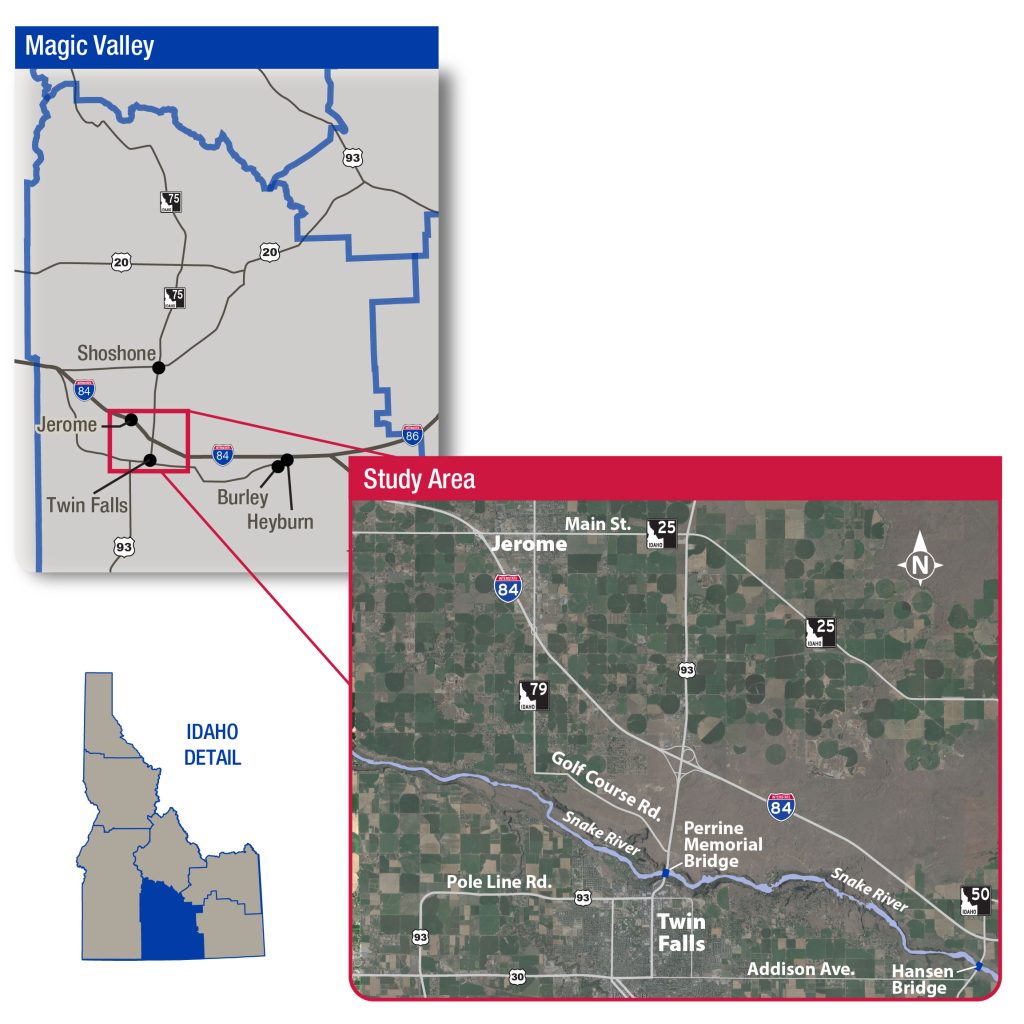
Currently, the Perrine Bridge (US-93) is the primary route across the Snake River, and limited crossing options can lead to significant delays, especially during congestion or closures. Traffic in the area is expected to continue growing, with volumes on the Perrine Bridge projected to double by 2050 and many nearby intersections expected to operate at a lower level of service conditions.
By improving the transportation network and adding redundancy, the project aims to reduce travel delays, improve mobility, and enhance safety for all roadway users. Other planned projects in the area, such as intersection and corridor improvements, will also be considered as part of the overall solution.
Alternatives were evaluated based on how well they meet project goals, including reducing congestion, improving mobility and emergency access, supporting freight movement, being cost-effective and fundable, and minimizing environmental and community impacts.
An initial set of 14 alternatives was screened using available data to identify any fatal flaws. From this, four alternatives were selected to move forward into the NEPA process. A No-Build alternative will also be included as a baseline for comparison. These alternatives will undergo more detailed analysis during NEPA, including environmental impacts, costs, and design considerations.
The public will be involved throughout this process.
The project aims to minimize impacts to the community, including both the built and natural environments. Potential impacts to the environment, residents, businesses, and the agriculture community will be carefully studied during the NEPA evaluation. Environmental resource agencies are consulted as part of this process, and data is collected and analyzed by subject matter experts.
ITD is working closely with the Magic Valley Metropolitan Planning Organization (MVMPO), which represents local cities and counties and develops regional growth forecasts. These 2050 forecasts will be incorporated into the project’s travel demand model to help understand future traffic patterns, roadway congestion, and how the transportation system may change over time.
Engaging agencies and the public will remain an important part of the process, building on previous outreach efforts. ITD will host public meetings and hearings at key milestones during the NEPA process.
Technical working groups made up of experts and community representatives will also provide input on project findings. These findings will then be shared with the public for review and comment.
All public comments are reviewed by the project team, including engineers and decision-makers. A summary report will be prepared after each public meeting, with all comments included and personal information redacted.
Contact the Snake River Crossing Project Team | Sign Up for Updates
Email: info@snakerivercrossing.com | Phone: 208-428-1800