
Overview
-
- Compile and analyze data around crashes along the SH-8 corridor from Snow Road to Troy.
-
- Use this traffic study to identify and program new safety projects.
-
- Relieve congestion points and improve travel times.
-
- Increase highway capacity for anticipated population growth and increased 2050 projected traffic counts.
-
- Modify the existing roadway in key areas to enhance rideability and conform to new standards.
Study Area
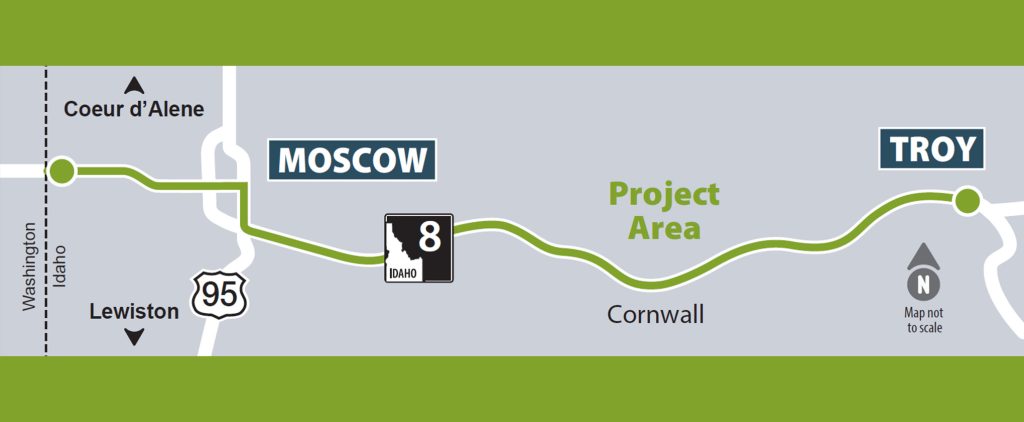
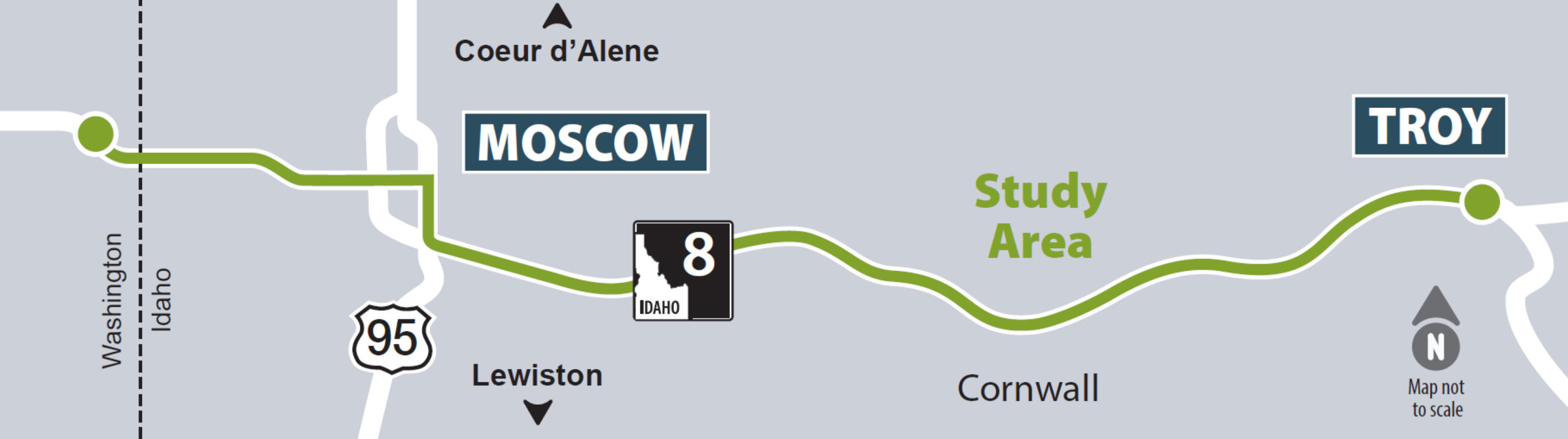
The SH-8 section in review extends roughly from Snow Road to Troy.
Community Engagement

Public and special interest groups are an important part of the decision-making process and success of these studies. ITD organized a technical advisory committee and community working group to provide input throughout the study process.
These partners included representatives from emergency services, education, commerce, community service organizations, Tribal members, and government agencies. At this particular stage, we are no longer using the established working groups. However, their participation has been instrumental in molding the study.
Additionally, at key milestones throughout the process, ITD has invited the public to review potential alternatives, ask questions, and provide ideas and feedback.
This public input, along with technical information and engineering best-practices, help shape community-appropriate solutions.
Public Meeting #1 – April 2024:
Archived Public Meeting #1 online meeting and map comments / roll plots
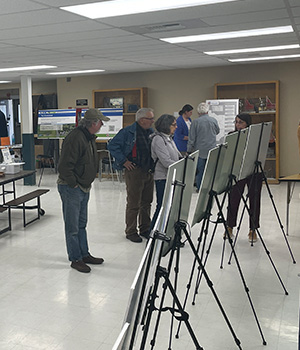
Working groups were utilized early in the process to gather ideas prior to the first public meeting. ITD hosted three in-person events on April 9, 10, and 11 in different cities to provide opportunities for people to attend throughout the two study areas. Participants were encouraged to drop in anytime between 4:30 to 7 p.m. Additionally, an online public meeting was available beginning April 9 at itdprojects.idaho.gov/pages/sh8-us95-pel.
The online experience contained the same information and a similar opportunity to submit comments as the in-person events. A total of 156 attendees signed in across the three in-person events (Potlatch: 19, Moscow: 117, Troy: 20).
The public shared ideas with the project team about a proposed deceleration lane near Mountain View Drive and a center turn lane near Mile 7. Several participants proposed installing new traffic signals or roundabouts at Mountain View Road and SH-8 Lenville/Plant Sciences Road. Additionally, there were conversations with the project team about building a US-95 bypass around the area and adding passing lanes specifically between mileposts 12 – 14 and mileposts 9 – 10.
Many participants were very interested in popular transportation topics such as speed, wildlife crossings, conditions, and improving turns around SH-8. There were several discussions about improving signage/delineation along the entire SH-8 corridor. Several community members suggested that the team should have looked at solutions that widened the corridor and added transit options. Pedestrian and bicycle safety enhancements also were discussed in depth and proposed near Gritman Medical Center, SH-8 to Ridgeview Drive, and the intersection of SH-8 and US-95.
Concerns regarding sight distance near the Big Meadows Intersection and Driscoll Ridge were brought up. Lastly, congestion along SH-8, thoughts about speed limits changes, and increased enforcement were additional topics.
All suggestions for possible improvements were considered by the study teams and were paired with engineering data to develop alternatives. Initial alternatives were screened by study teams for purpose and need; for feasibility, buildability, fundability; and through other criteria. The second public meeting was scheduled for June 2025 to share a range of potential improvements.
Public Meeting #2 – June 2025:
Archived Public Meeting #2 online meeting.
In-person events included a public meeting on June 24 followed by office hours on June 25. The public meeting was held in an open house format, and people were invited to drop by any time between 4 and 7 p.m. to view study information and speak with the study teams. An online public meeting was available beginning June 17 at www.us95sh8.com. The online experience contained the same information and a similar opportunity to submit comments as the in-person event. The comment period began officially on June 17, 2025, and remained open through July 8. There were a total of 1,436 participants and 165 comments between the two formats.
The study team received comments and information on specific locations for new SH-8 alignments. Several participants expressed support or concerns, including cost. Other themes included on-alignment widening and improvements such as turn and passing lanes. Additionally, community members brought up ideas for speed limits, incorporating the Latah Trail, and traffic signals like the intersection of Mtn. View Drive and SH-8.
ITD had reviewed all of the new comments, and as a result, the study team was currently applying engineering best practices and incorporating additional data, including traffic, environmental, and public feedback.
What will happen next?
A technical report outlining potential solutions should be finalized by spring 2026 for another comment opportunity. A copy of that report will be shared with community members via email and this project website.
The shift from Planning Environmental Linkages (PEL) Study to a Traffic Study
After reviewing crash data, potential new alignments, initial traffic analysis and public input, ITD has redefined the scope of the study needed on State Highway 8 from Moscow to Troy. At this time, the challenges and likely solutions to transportation issues on this highway are less robust than previously anticipated. The department will continue to pursue improving safety and traffic flow on SH-8 but will follow a more tailored process to determine those solutions.
This project will utilize all public input and efforts put into the PEL study up to this point and will identify solutions through a traffic study. This change will also shorten the timeline the study needs to be completed. ITD will continue to follow the PEL process for U.S. Highway 95 where traffic needs are greater and potential solutions more significant.
What’s next for SH-8? ITD will prepare a technical report by spring 2026 detailing potential solutions, which are expected to include smaller-scale improvements like passing lanes, turn lanes and the previously presented realignments. These expected recommendations are more in line with engineering review and public comments that have been received to date. Once the report is complete, ITD will share with stakeholders via email and the project website. In the meantime, stay up to date on this separate study by visiting this webpage.
Funding
The traffic study will generate projects in the future but no funding for design or construction has been identified at this time.
This traffic study is anticipated to be completed in the spring of 2026. At that time, we may have identified a range of potential improvements, and we can provide general timelines for next steps, including opportunities for current or future funding.
To see other projects that are currently funded, please view this PDF.
Timeline
-
Fall 2022
Data collection
-
Spring 2023
Initiate stakeholder meetings.
-
Winter 2023/2024
Develop project purpose and need for joint PEL.
-
Spring/Summer 2024
Develop and screen initial alternatives.
-
Fall 2024
Prepare Level 2 Screening Criteria. Refine Alternatives advanced from Level 1 Screening.
-
Winter 2025
Project team determines SH-8 should no longer follow PEL process with US-95.
-
Summer 2026
Complete traffic study.
Frequently Asked Questions
General Themes
You can visit: itd.aashtowaresafety.net/itd-safety-dashboards. Once there, you can filter by crash type and district. The SH-8 traffic study is located in ITD District 2.
Comments made during the public meeting comment period regarding roadway maintenance, including de-icer, sign locations, and vegetation on the roadside, will be shared with our District 2 Maintenance Team. You can also reach out via email to: PublicComments@itd.idaho.gov.
Active transportation refers to human-powered mobility including walking, riding a bike, using an e-scooter, or rolling a wheelchair. It can also include facilities to promote or support these activities like walking to rideshare or other forms of public transportation. We received many comments about concerns and opportunities for those who walk and bike in the study areas. In addition to the Active Transportation Workshop conducted in the fall of 2023, our study teams will continue to consider the safety and needs of those who walk, roll, and bike, including review of and opportunities for crosswalks, bike lanes, and other active transportation facilities. Many commenters asked us to study SH-8 east to Ridgeview Drive and US-95 at Styner/Lauder Ave. These areas will be studied as part of this study.
ITD and other jurisdictional agencies will continue to work together to determine active transportation solutions, how they get implemented, and by who.
Many commenters offered specific locations to consider for new turn and passing lanes in light of how the roadway is designed and the impact on visibility. Several mentioned that speed, aggressive driving, and agricultural equipment were also contributing factors in their request for roadway improvements, including turn lanes and passing lanes.
Specific locations for passing lanes on SH-8 were mentioned between mileposts 12 and 14 and between mileposts 9 and 10. A deceleration lane was mentioned near Mountain View Drive, and a center turn lane near milepost 7 (west of Teare and Reams roads). Our roadway teams will consider these concerns and suggestions as part of this study.
Some areas of US-95 and SH-8 are already being studied or funded as projects for future construction outside of the PEL process. Those projects, which may include new turn and passing lanes, can be found here: Latah County Projects, 2024–Early Development.
Process and Outreach
Community values and perceptions are an important piece of data for short and long range planning. Public comments are reviewed by our study team including engineers and decision makers. A summary document will be created and published once the traffic study is completed.
We also gather and consider:
- Traffic and crash data
- Environmental resource data
- Existing community and regional
These data sets, together with engineering best practices, can help our teams identify transportation problems and possible solutions.
Sign up for updates
Downloads and Resources
Public Meeting #1 – April 2024:
Public Meeting Summary (without map comments and roll plots)
Public Meeting Summary (only map comments and roll plots)
Online Meeting (archived)
Public Meeting #2 – June 2025:
Public Meeting Summary
Archived Public Meeting #2 online meeting
SH-8 PEL Study Materials:
Contact
Project Manager Janet Zarate: Janet.Zarate@itd.idaho.gov