Overview
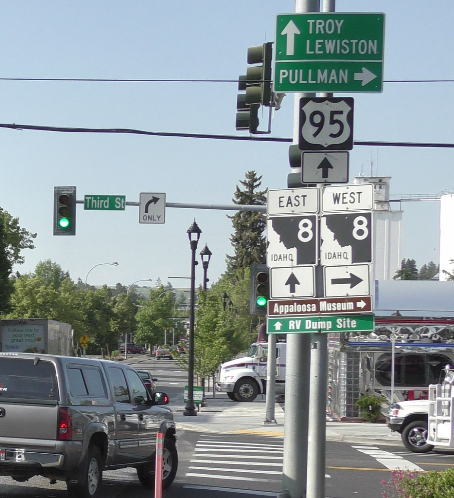
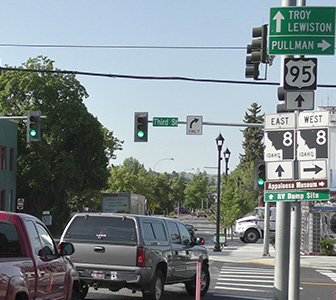
Studying two intersecting corridors, US-95 and SH-8, in Latah County.
June 2025 Public Meeting Summary
The June 2025 public meeting summary is now available. Responses to frequently asked questions are included in the summary document and the Frequently Asked Questions section of this site.

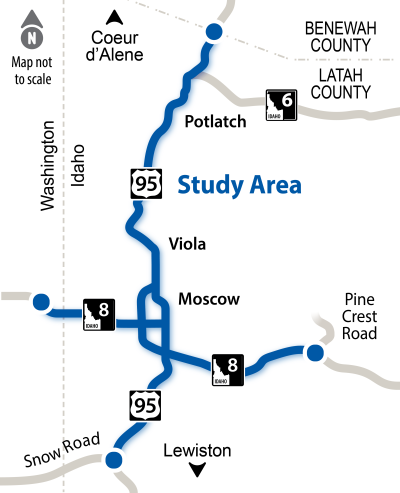
The Idaho Transportation Department initiated the US-95 Palouse Region Study to help determine investments on US-95 between Snow Road and the Latah/Benewah county line to improve safety, mobility, and economic opportunity in the region.
Overview
Current traffic volumes coupled with predicted growth in the area prompted the need for the study to identify the current and future transportation needs and strategies to address them.
The research completed as part of this study will help ITD better understand environmental considerations, community goals, and growth.
The study team will also analyze:
- Safety features
- Congestion
- Traffic operations
- Multi-modal connections (walking and biking)
- Travel time
Using stakeholder feedback and engineering data, the study team will develop, evaluate, and screen potential solutions to meet the needs of the area. These efforts will aid ITD in identifying projects and priorities that can more effectively be advanced into further engineering and National Environmental Policy Act (NEPA) requirements.
Schedule
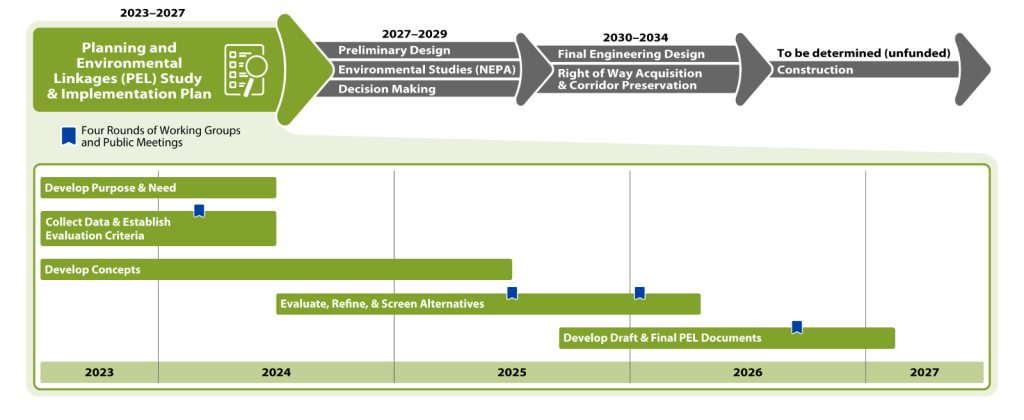
The PEL process is just the first step of many phases. Only the PEL phase is currently funded, and timelines may update.
Community Engagement
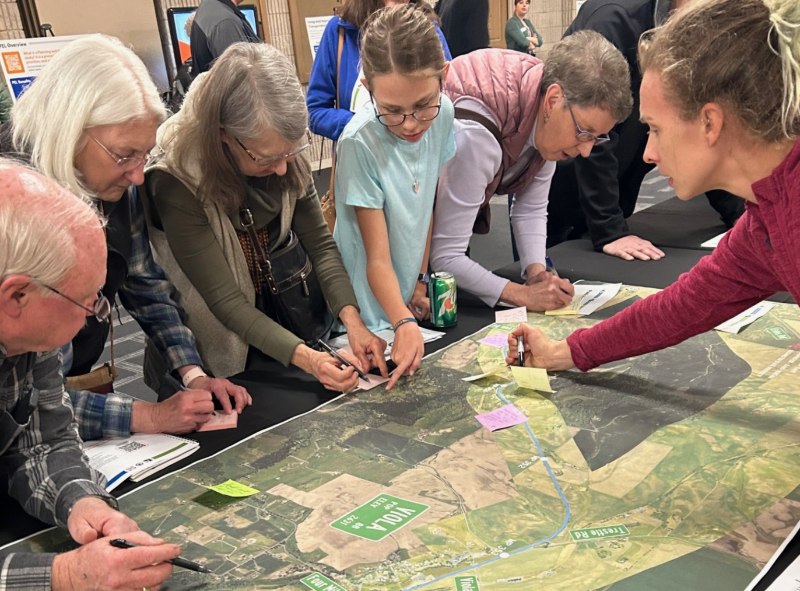
Public and stakeholder involvement are an important part of the decision-making process and success of this study. ITD has organized a technical advisory committee and community working group to provide input throughout the process. These partners include representatives from emergency services, education, commerce, community service organizations, tribal members, and government agencies.
At key study milestones, ITD will invite the public to provide input on potential design concepts and evaluation criteria and ask questions. This public input, along with technical information and engineering best-practices, help shape community-appropriate solutions.
To learn more about opportunities for input, or if you have questions, please email info@us95sh8.com.
Public Meetings
Two public meetings have been held since the study was initiated. For more details, visit the Downloads and Resources below.
April 2024 Public Meeting: The public was invited to share their concerns about transportation problems and ideas for potential solutions. Meetings were held in Troy, Potlatch, Moscow, and online. The most frequently mentioned themes included:
June 2025 Public Meeting: ITD hosted an event in Moscow and online to gather input on the first round of preliminary design concepts and early evaluation results, in addition to evaluation criteria for the next phase of concept screening. Frequently mentioned themes included:
Visibility and sight distance
Sharp curves and turns
Intersection types
Lane and shoulder widths
Turn lanes:
- Viola Junction
- Estes Rd
- Potlatch Junction
- Others north of Moscow
Passing lanes:
- Potlatch
- Steakhouse Hill (Moscow Mountain)
- Others north of Moscow
Traffic congestion and signage
Comments or information on specific locations, including Washington options
Support or concerns:
- Specific locations were given including Washington options
- More comments mentioned and supported western concepts than eastern concepts
Urban Mobility Concepts:
- A Street
- Palouse River Drive
Preference for an alternative route, including suggestions for:
- East of Moscow
- West of Moscow
- North of Moscow
- South of Moscow
Dislike for alternative routes
Turn and Passing Lanes, including Phillips Farm
Pedestrian Improvements, including Gritman Hospital Crossing
Traffic Signals
Walking and biking
Crosswalks
Cost
Environmental Considerations, including farmland and farmers
Study Details
Vision and Purpose & Need
Purpose & Need Statements are established prior to the development of concepts to clarify the expected outcome of the proposed action. They are used as a baseline to develop, evaluate, and eliminate concepts and guide the decision-making process.
The team gathered public and agency input to develop the following Vision and Purpose & Need statements for this study.
Vision: To determine purposeful investments in the transportation network to improve safety and mobility and serve the communities and regional economic needs.
Purpose: Why improvements are being proposed and the desired transportation outcomes
The purpose of the transportation improvements on US-95 between Snow Road and the Latah/Benewah county line is to enhance quality of life through transportation by:
- Reducing congestion through improved travel time reliability
- Continuing to enhance a regional north-south connection between Lewiston and Coeur d’Alene as an important element of local and regional commerce
- Accommodating walking and biking where appropriate on the U.S. highway system
- Promoting safety by addressing geometric and operational deficiencies
Need: Transportation needs to be addressed and the underlying causes of the problems
The need for transportation improvements on US-95 between Snow Road and the Latah/Benewah county line includes:
Geometric and operational deficiencies on the US-95 corridor, including deficiencies associated with horizontal and vertical curves, substandard grades, narrow shoulders, and passing opportunities
Current and future (2050) congestion
Inefficient movement of freight and through traffic on the one-way couplet due to the 25-mph design speed, on-street parking, and sharp turning radii at the intersections of SH-8 and US-95
Inadequate or lack of accommodation for travelers walking and biking to school, work, and shops
Concepts and Evaluation
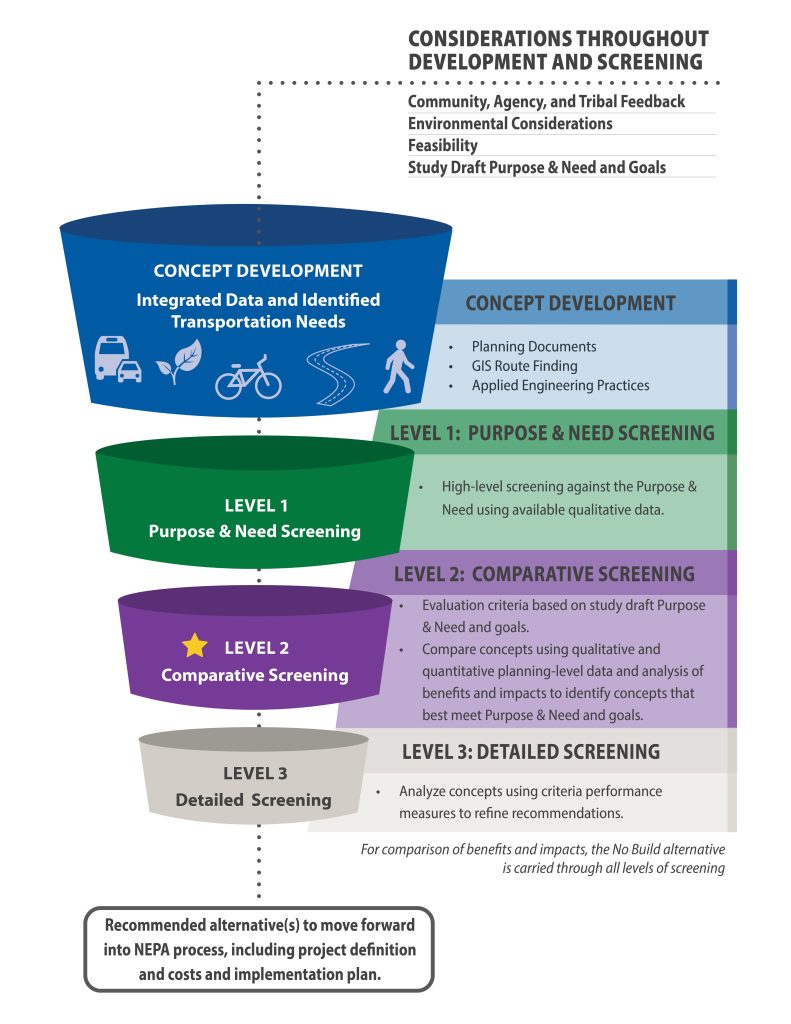
The US-95 Palouse Region Study is following the Planning and Environmental Linkages (PEL) process, which includes several levels of screening to evaluate concepts that consider the transportation problems, operational context, and surrounding environment.
For this study, concepts range from broad to targeted, rural to urban. As we move through each step of the process, concept details will be refined. Multiple reasonable concepts may advance and will be called alternatives if they are recommended at the conclusion of the study. For information about the initial concepts and results from the first round of evaluation, please view the Level One Screening Results Pamphlet.
On-Alignment Concepts
Improvements would be considered for the current highway system. While the details of specific improvement elements would be refined throughout the process, we want to forecast what is possible for updates on the current roadway system.
Rural Improvements
- Widening
- Targeted roadway improvements outside Moscow city limits
Urban Improvements
- Targeted roadway improvements in Moscow
- Standalone improvements for walking and biking
New Alignment Concepts
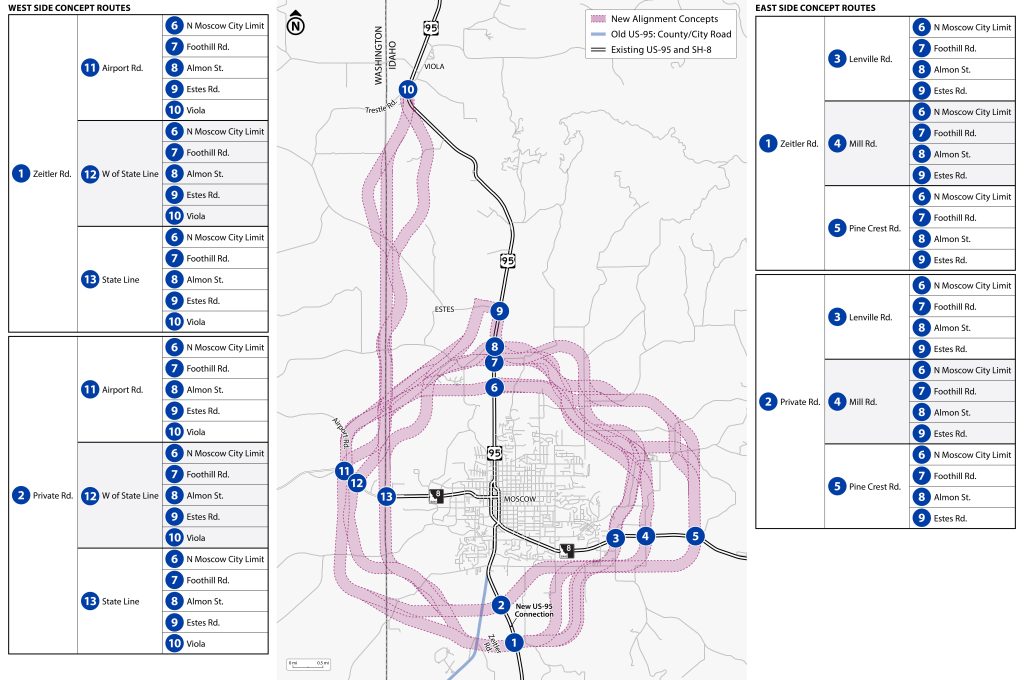
New connections and roadways would be considered off the current highway system. Because we build new roads to the latest design standards, many roadway elements would be determined by engineering best practices and technical data at the time of final design and construction.
New Corridors
- New roadway corridors could be created to address the problems on US-95 and SH-8
New Routes for Urban Mobility
- These concepts would help roadway users move around and through the Moscow area
Frequently Asked Questions
General Themes
You have a few options for learning about crashes in the study areas:
- You can visit: itd.aashtowaresafety.net/itd-safety-dashboards. Once there, you can filter by crash type and district. The US-95 and SH-8 studies are located in ITD District 2.
- Or, at the next public meeting in early 2025, a map dashboard will be available that is specific to each study area. Layers will include filterable crash data, including data on all crash types.
Comments made during the public meeting comment period regarding roadway maintenance, including de-icer, sign locations, and vegetation on the roadside, will be shared with our District 2 Maintenance Team. You can also reach out via email to: PublicComments@itd.idaho.gov.
Active transportation refers to human-powered mobility including walking, riding a bike, using an e-scooter, or rolling a wheelchair. It can also include facilities to promote or support these activities like walking to rideshare or other forms of public transportation.
We received many comments about concerns and opportunities for those who walk and bike in the study areas. In addition to the Active Transportation Workshop conducted in the fall of 2023, our study teams will continue to consider the safety and needs of those who walk, roll, and bike, including review of and opportunities for crosswalks, bike lanes, and other active transportation facilities. Many commenters asked us to study SH-8 east to Ridgeview Drive and US-95 at Styner/Lauder Ave., around the Moscow Food Co-op, the University of Idaho, downtown Moscow, and Gritman Medical Center. Those areas will be studied as part of both PEL studies.
ITD and other jurisdictional agencies will continue to work together to determine active transportation solutions, how they get implemented, and by whom.
Many commenters suggested alternative routes as possible solutions for transportation problems on US-95 and SH-8, offering supporting factors like:
- Needed safety improvements
- Considerations for pedestrians and bicyclists
- Traffic congestion
- Needs of freight and equipment
- Commerce and growth
- Access
Other commenters suggested improvements of the existing roadway, with some suggesting upgrades to a four-lane highway. Others cautioned specifics around eastern or western alternative routes, or cautioned new alignments altogether with concerns including environmental considerations, right of way, and costs.
As ITD moves the study forward, possible alternative alignments and revisions to existing roadways will be considered. We have involved and will continue to collaborate with the cities, counties, federal government, Pullman-Moscow Regional Airport, the University of Idaho, City of Pullman, and Washington State Department of Transportation, among others.
The study is centrally located in the Palouse Region of Idaho. We are studying environmental resource categories for each study area and consider this data as part of the PEL process, including:
- Visual
- Agricultural and forest
- Air quality
- Biological
- Cultural
- Geology and soils
- Hazards and hazardous materials
- Hydrology and water quality
- Land use and transportation planning
- Noise
- Social and economics
- Palouse Prairie Remnants
Environmental data is collected through field surveys and analyzed by subject matter experts. Environmental agencies are consulted as needed.
Many commenters offered specific locations to consider for new turn and passing lanes in light of how the roadway is designed and the impact on visibility. Several mentioned that speed, aggressive driving, and agricultural equipment were also contributing factors in their request for roadway improvements, including turn lanes and passing lanes.
Frequently requested turn lane locations for US-95 were Phillip’s Farm Park, Viola, Estes, and other areas north of Moscow. Some commenters also made suggestions regarding additional turn off roadway options for these areas.
Our roadway teams will consider these concerns and suggestions as part of these studies.
Some areas of US-95 and SH-8 are already being studied or funded as projects for future construction outside of the PEL process. Those projects, which may include new turn and passing lanes, can be found here: Latah County Projects, 2024–Early Development. Visit itdprojects.idaho.gov for information about all ITD projects.
The concepts for the study were developed through engagement with stakeholders and the public during 2023 and 2024, including a public meeting in April 2024, and informed by previous planning work by ITD and the City of Moscow. Community members contributed their perspectives and ideas for transportation solutions, resulting in hundreds of suggestions that informed the development of concepts. The study team applied engineering best practices and incorporated additional data, including traffic, environmental, and public feedback. The team’s traffic analysts studied conditions in 2023 and projected what may occur in 2050 with no changes.
Traffic analysts examined conditions in 2023 and projected future scenarios for 2050 without any changes. In the initial evaluation phase, the team assessed whether the screened concepts would meet the project’s Purpose & Need. In the subsequent phase, more detailed data, including traffic data, will be collected and analyzed for each concept that passed the initial screening. Evaluation criteria for the Level Two Screening was presented to the public for feedback at the public meeting in June 2025. This approach allows the team to compare the benefits of each concept effectively. Delaying the detailed traffic analysis is strategic, enabling the study team to concentrate on concepts that align with the project’s Purpose & Need. The public can anticipate more detailed information on the concepts as the study advances.
Currently, potential new corridors have been identified within 1,000-foot-wide bands to allow for route and alignment optimizations when considering a wide range of built environment and natural resources factors. Over the next year and a half, the team will utilize additional data to refine these potential corridor areas. Given the economic and geographic connections between Pullman and Moscow, the study team is focusing on routes that connect in Washington and will continue to collaborate with Whitman County and WSDOT to assess the feasibility of these options.
The study team considered the rail corridor, but it was not a candidate for a new state highway due to its width restrictions and associated impacts to the built environment.
The study team prioritizes long-term planning for community members by conducting outreach to integrate local and regional planning efforts into the transportation considerations of the study. So far, the team has completed 46 stakeholder interviews and held two community working groups, with two additional workshops planned for the duration of the study. This outreach has involved engagement with both small and large businesses, the chamber of commerce, and the university. The study process includes compliance and adherence to planning and regulatory documents, including city and county master planning documents and transportation plans, and the Uniform Relocation Assistance and Real Property Acquisition for Federal and Federally Assisted Programs (49 CFR Part 24).
The costs associated with the Thorn Creek project do not impact the funding for the US-95 study. While the planning study is currently funded, funding for future construction has not yet been secured. For information about transportation program funding, visit: itd.idaho.gov/funding.
The purpose of this study is to develop short-, mid- and long-term transportation solutions for the Palouse Region study area. At this early planning stage, ITD has not identified future right of way acquisitions or funding for any potential construction projects.
ITD follows a standard process when right of way is needed for a project. Potentially affected property owners are consulted during the design process, including an initial contact when all impacts may not be known. Communication continues throughout the design process until the project is construction-ready. Most projects are planned seven years in advance.
Currently, the study is funded through planning, and no funding is identified for future design and construction phases, meaning homeowners shouldn’t expect to hear from the department until more funding is identified.
ITD follows federal guidance when acquiring easements or property. This process is outlined in the Uniform Relocation Assistance and Real Property Acquisition for Federal and Federally Assisted Programs (49 CFR Part 24).
PEL Process and Outreach
During the interview process in the earliest phase of the study, community leaders and technical experts were asked to help identify working group members who could bring a wealth of specialized knowledge to the table. Their expertise and leadership enable them to offer invaluable insights that help shape the direction and success of the study.
The Community Working Group includes representatives from local, state, and tribal governments; educational institutions; emergency services; businesses; non-profit and community organizations; and active transportation groups. The Technical Advisory Committee includes government agencies, airport, utilities, and transportation experts.
The working groups serve in a collaborative role to ITD to help identify community values and a vision for transportation in the area. Members of the groups will also provide feedback on possible outcomes for the study.
Community values and perceptions are an important piece of data for these studies. Public comments are reviewed by our study teams including engineers and decision makers. A summary document will be created and published for each round of public meetings with all comments available for review (with personal information redacted).
We also gather and consider:
- Existing roadway conditions data in the corridors
- Traffic and crash data
- Environmental resource data
- Existing community and regional
These data sets, together with engineering best practices, can help our teams identify transportation problems and possible solutions.
To date, public feedback has been gathered and incorporated as possible during the development of the draft Purpose & Need statements and concept development. The public was invited to share ideas for transportation solutions, either by drawing on maps or as written comments, during the first public meeting. Their ideas were then overlayed with engineering data to create the concepts that moved into the Level One Screening. Feedback gathered on the concepts and results of the Level One Screening at the June 2025 public meeting will be considered during Level Two Screening.
Currently, we do not have a timeline for potential projects. No construction funding is currently identified for projects resulting from the studies. The PEL process begins without identified transportation solutions; we first analyze existing conditions of the corridors, study traffic patterns and congestion, and ask the public what transportation problems should be considered in the study areas. We are gathering your input and other data.
ITD’s transportation studies look out 25-30 years when forecasting future conditions, which is why we have established the year 2050 as part of our study. It helps us consider traffic problems that may occur without improvements or changes.
At the conclusion of these studies, the US-95 and SH-8 study teams may propose short and long-term improvements that, if funded, could progress through a NEPA process. Our PEL studies are anticipated to be completed in early 2027. At that time, we may have identified a range of potential improvements, and we can provide general timelines for next steps, including opportunities for current or future funding.
That said, ITD and Latah County have additional ongoing studies, design and construction projects that may overlap with our study areas. Those projects may be found here: Latah County Projects, 2024–Early Development. Visit itdprojects.idaho.gov for information about all ITD projects.
For more details on the PEL process and NEPA, please visit: environment.fhwa.dot.gov/env_initiatives/PEL.
This PEL study is the first step to developing a list of users’ needs and identifying the future configuration of US-95 and SH-8. The US-95 and SH-8 Planning and Environment Linkages (PEL) Studies are being developed pursuant to 23 Code of Federal Regulations (CFR) 450.212 (a)-(c), 23 CFR 450.318 (a)-(d), 23 United States Code (U.S.C.) 168 (d), Federal Highway Administration (FHWA) regulations, and ITD procedures regarding incorporation of the results of transportation planning studies as part of the overall project development process consistent with National Environmental Policy Act (NEPA) of 1969. The results of the PEL study are intended to be adopted or incorporated by reference into future NEPA processes.
Future environmental clearance processes will be prepared in accordance with the requirements of NEPA, as amended (42 U.S.C. 4321, et seq.), 23 U.S.C. 139, CEQ regulations implementing NEPA (40 CFR 1500-1508), FHWA regulations implementing NEPA (23 CFR 771.101-771.139),and applicable federal, state, and local laws and regulations.
Planning products may be adopted or incorporated by reference by an agency conducting an environ-mental review (e.g., an Environmental Assessment [EA], Environmental Impact Statement [EIS], or other documentation) to meet NEPA requirements if (1) the legal conditions for the PEL study are met during the transportation planning product development and (2) the planning products meet PEL authority and NEPA requirements. Section 168 defines planning products to include Purpose and Need statements, preliminary screening of alternatives, elimination of unreasonable alternatives, and other planning decisions and analyses.
ITD advertises for public meetings through:
- Postcards
- Newspaper advertisements, both print and digital
- Social media
- Emails to those who signed up for updates
- ITD Projects website
- Townhall Idaho
- Press release
Downloads and Resources
Public Meeting #1 – April 2024
Public Meeting Summary (without map comments and roll plots)
Public Meeting Summary (only map comments and roll plots)
Online Meeting (archived)
Invitation Postcard
SH-8 PEL Study Materials:
SH-8 Moscow to Troy Traffic Study
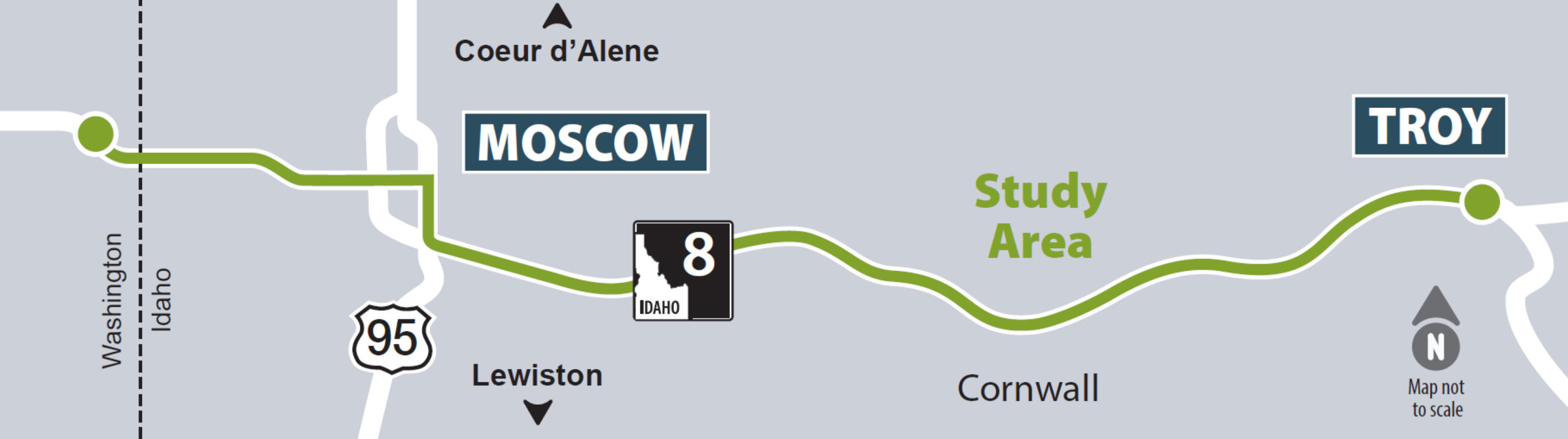
After reviewing crash data, potential new alignments, initial traffic analysis and public input, ITD has redefined the scope of the study needed on State Highway 8 from Moscow to Troy. At this time, the challenges and likely solutions to transportation issues on this highway are less robust than previously anticipated. The department will continue to pursue improving safety and traffic flow on SH-8 but will follow a more tailored process to determine those solutions.
This project will utilize all public input and efforts put into the PEL study up to this point and will identify solutions through a traffic study. This change will also shorten the timeline the study needs to be completed. ITD will continue to follow the PEL process for U.S. Highway 95 where traffic needs are greater and potential solutions more significant.
What’s next for SH-8?
ITD will prepare a technical report by spring 2026 detailing potential solutions, which are expected to include smaller-scale improvements like passing lanes, turn lanes, and the previously presented realignments. These expected recommendations are more in line with engineering review and public comments that have been received to date. Once the report is complete, ITD will share with stakeholders via email and the project website. In the meantime, stay up to date on this separate study by visiting itdprojects.idaho.gov/pages/sh-8-moscow-to-troy-traffic-study.